Small apartment storage ideas that begin with the plan
Small apartment storage ideas that actually work start with the plan: built-in volume, circulation, and furniture with two jobs.
You have just bought a small apartment and want the storage sorted before you move a single box in. You already live there and feel like you are constantly working around what you own. Or you are furnishing one to let, and want it to show as spacious as it can. Small apartment storage ideas found online are mostly lists of gadgets and baskets — the real gains come from the plan itself, before a single organiser is bought.
Storage is a plan decision, not a shopping list
A stackable box or a set of matching baskets can tidy what is already there, but it cannot create space that does not exist. Real storage capacity comes from decisions made on the plan, before the walls are painted or a single shelf is bought: which wall gains depth, which door disappears into a pocket, which corner stops being wasted.
This does not mean every small apartment needs building work. It means the useful question is never "what do I buy" but "where does this apartment actually have room to hold things it is not using yet". Once that question is answered, the furniture and fittings that follow are simply the ones that fit the answer.
Built-in volume: start from the wall, not the shelf
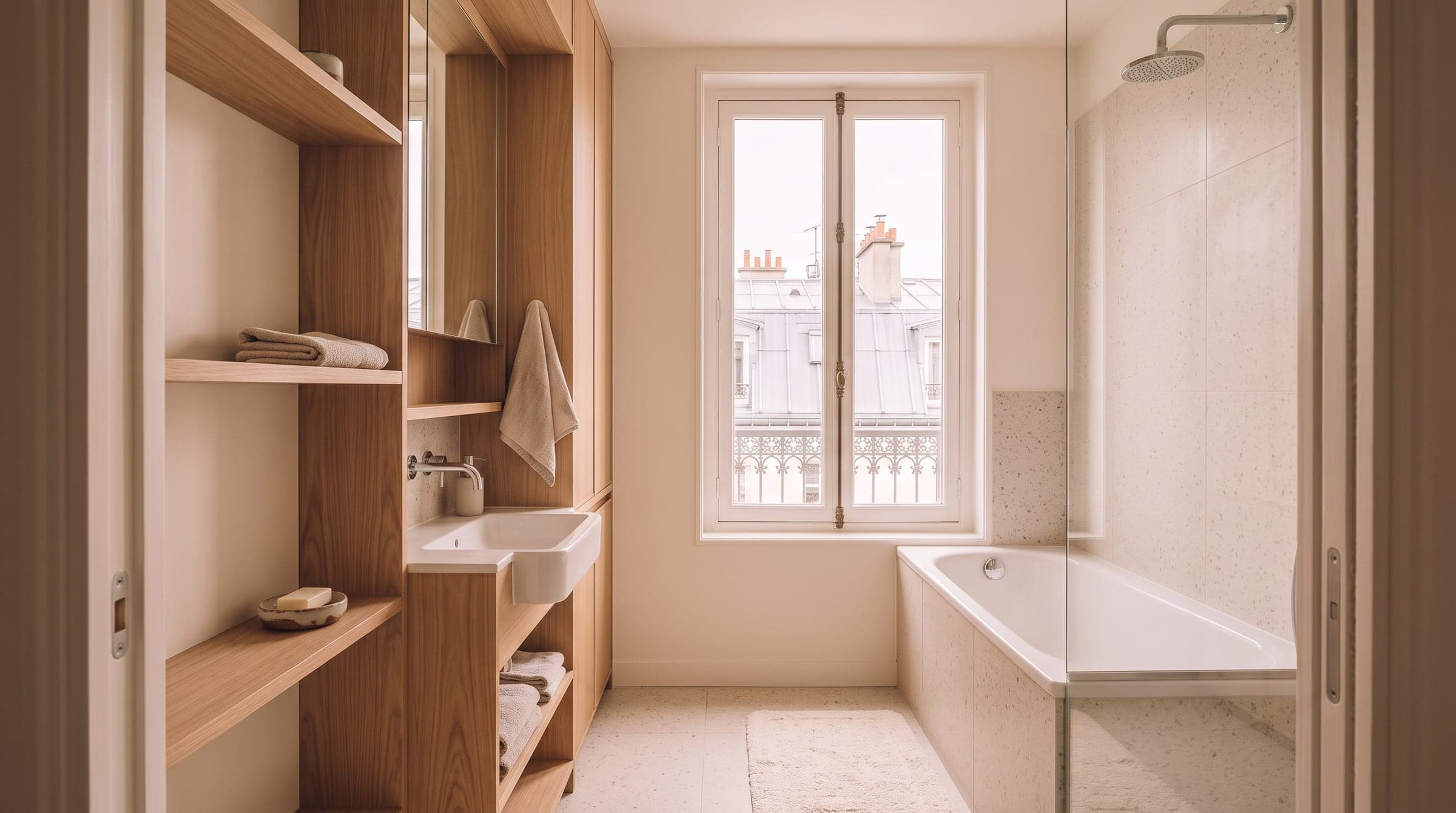
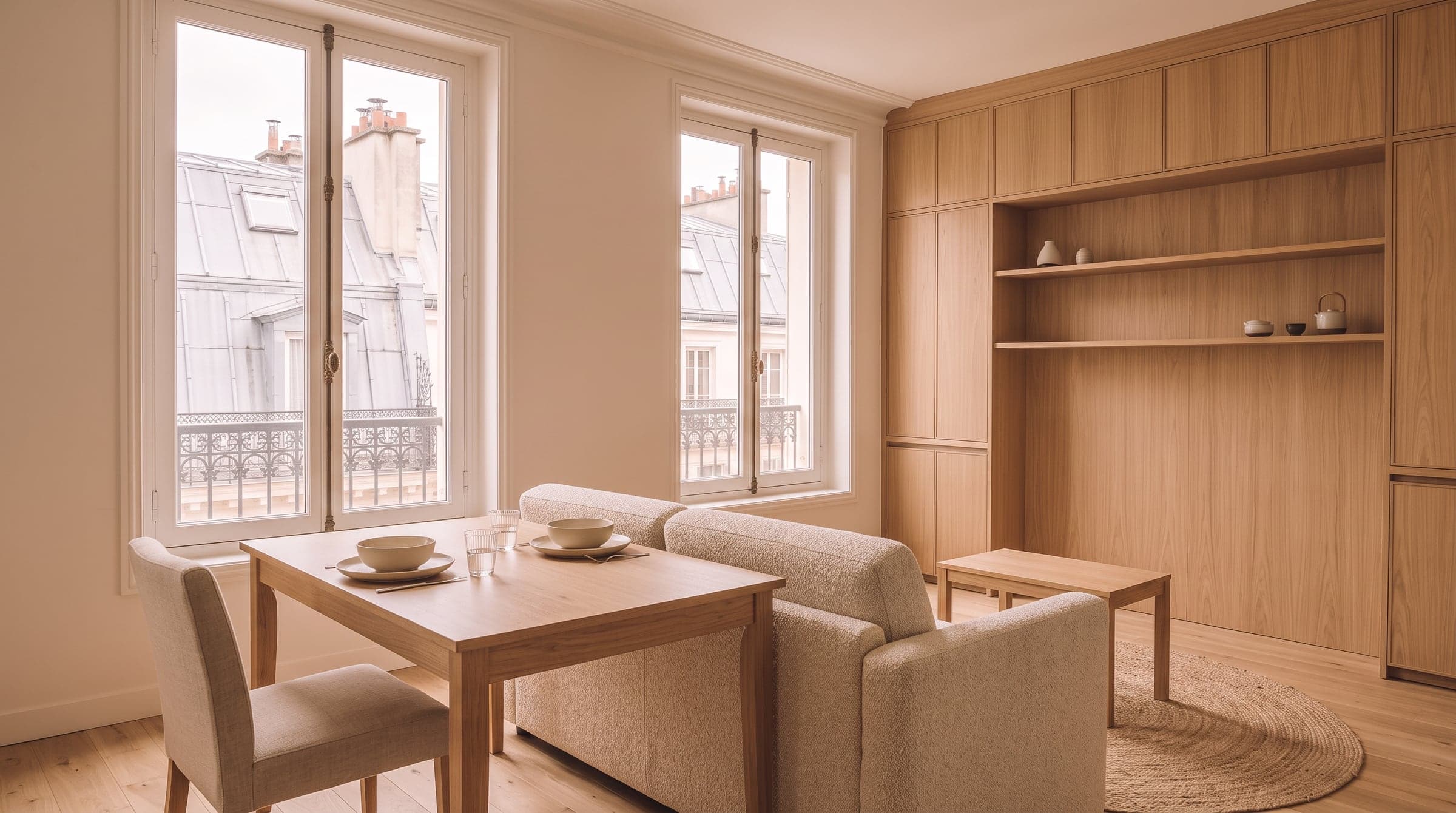
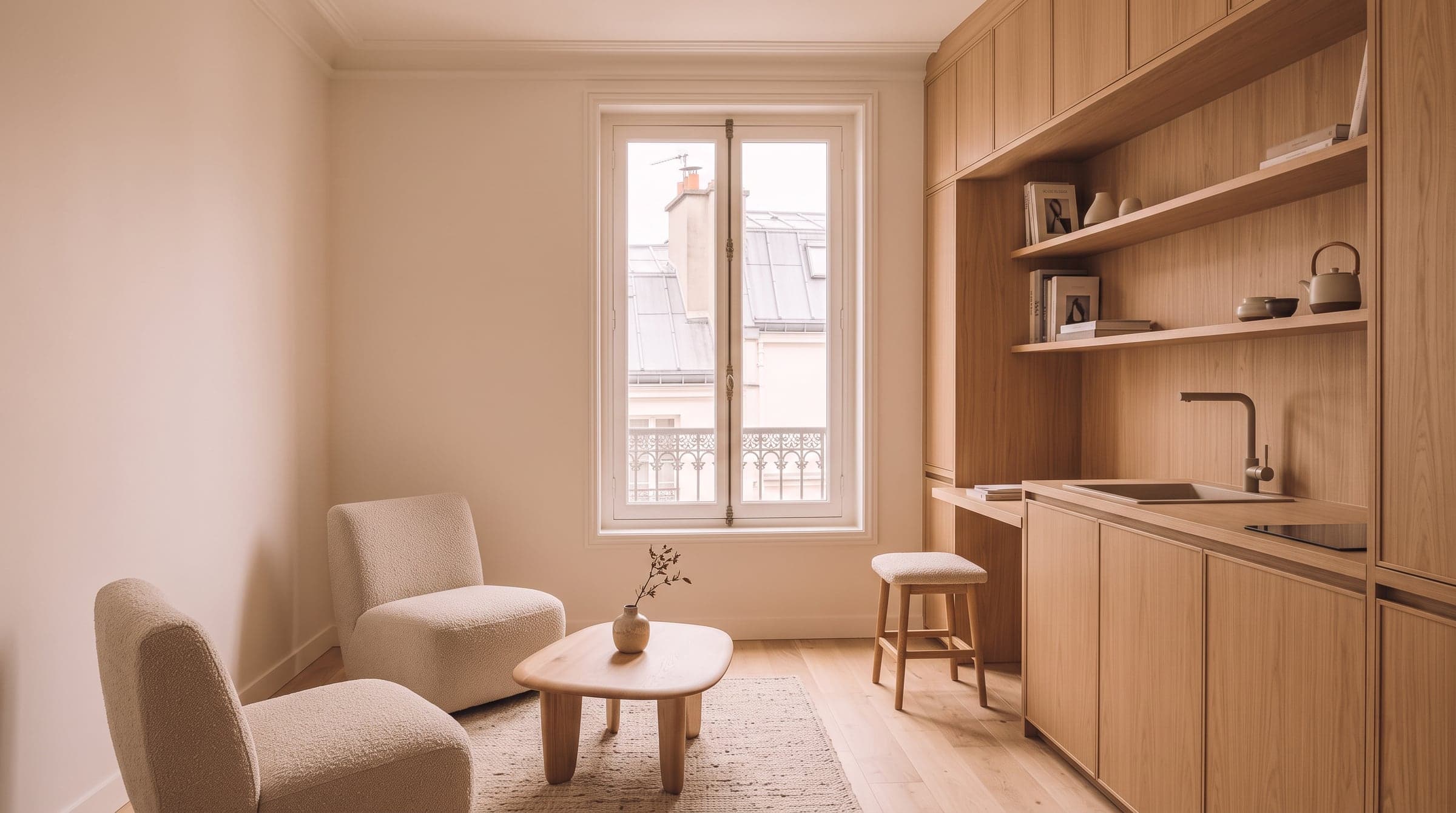
The wall itself is usually the largest untapped storage volume in a small apartment. A run of cabinetry built into the depth of a wall, rather than standing proud of it, can hold as much as a freestanding wardrobe while giving back several centimetres of floor to the room. Around a doorway, the same logic applies: cabinets can wrap the frame on both sides and above it, turning a dead strip of wall into genuine shelving.
Height matters as much as depth. A cabinet that stops a third of the way up the wall wastes the space above it; one that runs to the ceiling turns that same wall into roughly a third more storage, at the cost of a step stool for what is used rarely. The least-used items — seasonal things, spare linen, luggage — belong up there; daily items stay within reach.
The biggest small apartment storage idea is rarely a product — it is a wall drawn to the ceiling.
Circulation decides what storage can go where
Storage and circulation compete for the same metres, and circulation should win first. A hallway narrower than about ninety centimetres cannot safely carry any storage at all, however shallow; beyond that, it can often take a run of low cupboards or coat hooks without ever feeling tight. The swing of a door is part of this calculation too — a door that opens outward into a hallway can block a full metre of what would otherwise be usable wall.
This is also why storage decided room by room tends to disappoint: a wardrobe that makes sense in the bedroom might be exactly what blocks the one useful passage in the flat. Looking at circulation across the whole apartment, before placing a single piece of storage, is what prevents that kind of conflict later.
Furniture with two jobs
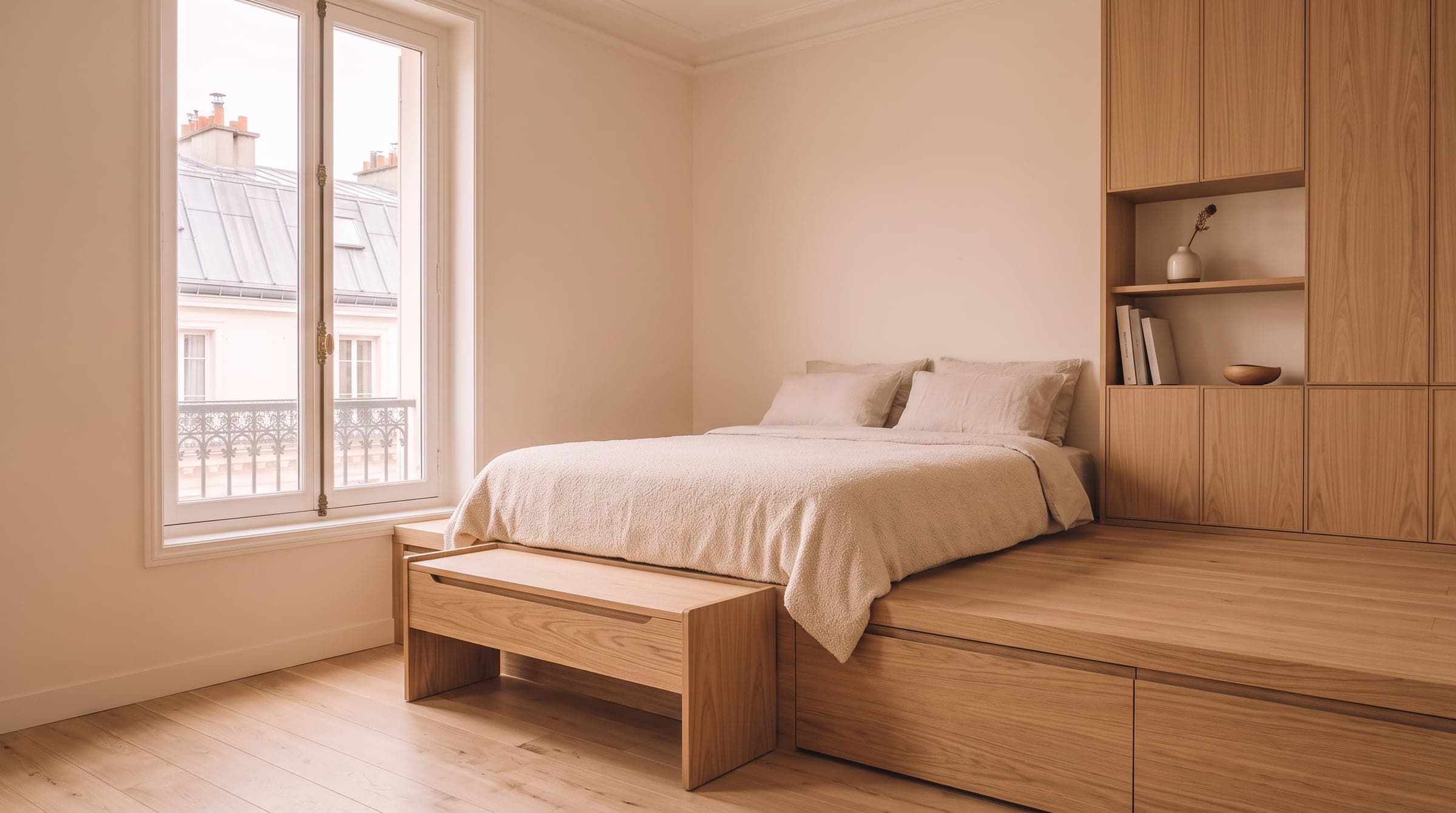
In a small apartment, furniture that only does one thing is a luxury. A bench with a hinged seat stores as much as it seats; an ottoman doubles as a coffee table and a lid over folded blankets; a bed platform raised on drawers turns the space under the mattress, otherwise wasted, into the largest single storage volume in the room.
The best of these pieces are drawn for one specific spot rather than bought at a standard size — a bench cut to the exact width of a window bay stores more and sits better than one bought a few centimetres short or long. This is where furniture made to measure earns its place: a piece built to the millimetre for your wall works harder than the same idea bought off the shelf.
The corners nobody uses
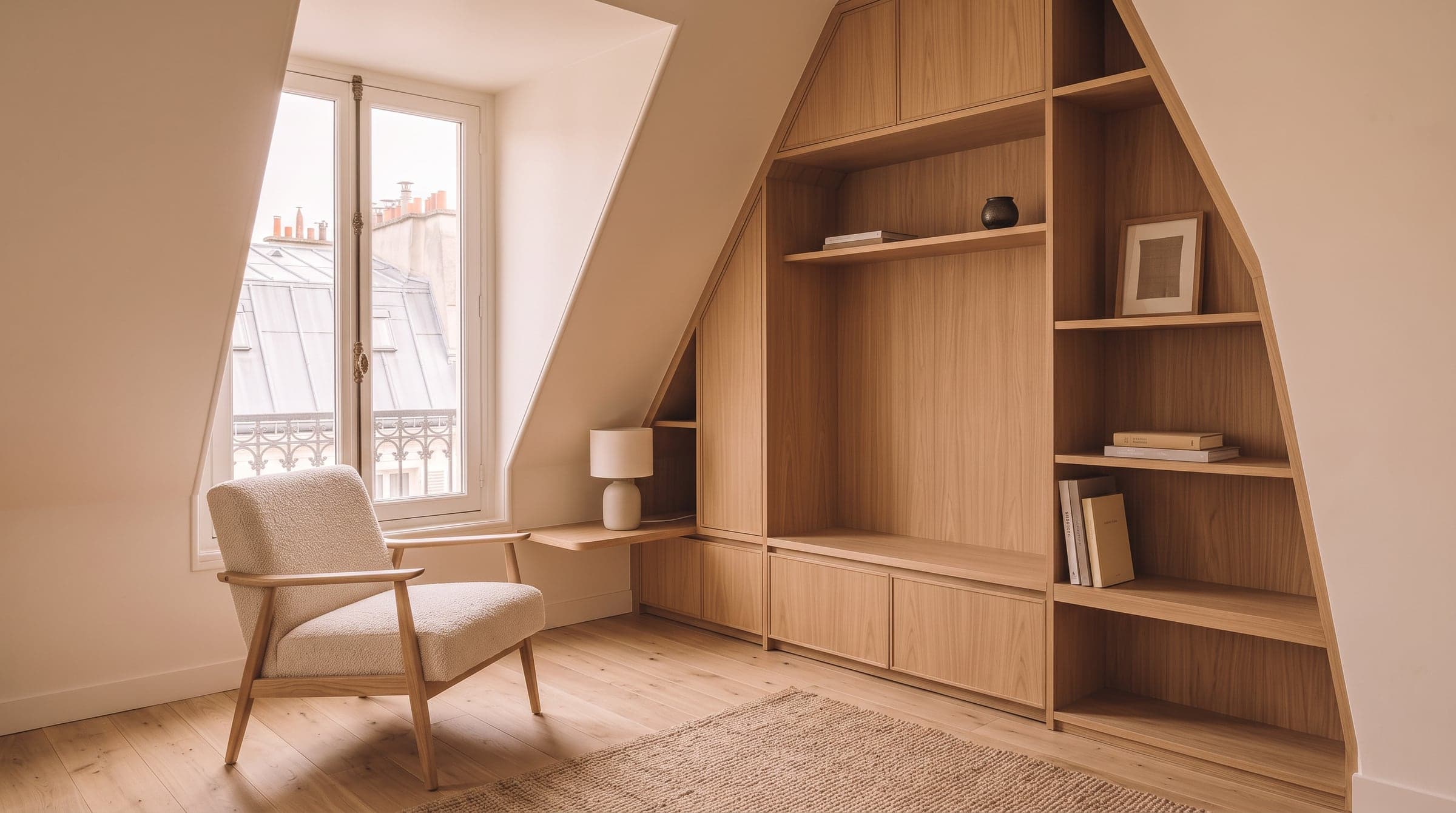
Every small apartment has at least one space it has quietly given up on: the triangle under a sloped ceiling, the gap beside a chimney breast, the strip above a door frame, the void under a staircase. None of these corners can hold a full-size wardrobe, and that is precisely why they are usually left empty — but a shelf, a drawer unit or a cupboard drawn to their exact, irregular shape can put every centimetre of them to work.
These corners are also where standard furniture fails most visibly: a rectangular cupboard pushed into a sloped-ceiling corner leaves a wedge of dead air behind it that nothing else can use either. Drawing storage to the actual angle of the room, rather than to the nearest catalogue size, is what turns these leftover corners into some of the most efficient storage in the whole apartment.
The file that gets it built
Whether you have just bought the apartment, already live in it, or are preparing it to let, the method starts the same way: the plan of the apartment as it is, then as it could be, with every wall, recess and doorway measured before any storage is drawn. You then see the rooms in perspective, in their real proportions and light, so a built-in wall or a corner unit is validated before it is built.
At the end, you receive a file with exact measurements, the drawing of every piece of joinery and furniture, ready for your contractor — or the right one, if you do not have one yet and would like us to help you look. The right craftsmen then build what has been drawn, and we stay available afterwards for any question or adjustment. Seeing where a renovation budget typically goes before choosing helps decide how much of it built-in storage should claim. This is what we draw for every small-space project: storage that comes from the plan, not from a list of things to buy.
FAQ
What is the single biggest small apartment storage idea that actually works?
Going to the ceiling. Built-in cabinetry that runs from floor to ceiling, rather than stopping at head height, typically adds around a third more storage on the same wall, for the price of a step stool to reach the top shelves. It works in nearly every room and needs no extra floor space at all.
Do I need built-in storage, or can freestanding furniture work just as well?
Freestanding pieces are easier to change later, but built-in storage nearly always holds more, because it can be drawn to the exact depth, height and shape of the wall rather than a standard size. In a small apartment, that difference — a few centimetres gained on every wall — adds up to a real amount of usable space.
How do I find storage for an oddly shaped corner or a sloped ceiling?
Standard furniture is built for square corners and flat ceilings, so it rarely fits well in either. The reliable approach is to measure the actual angle and draw the piece to it — a unit built for one specific sloped corner uses all of it, where a rectangular cupboard pushed into the same space leaves a wedge of it unused.
Does better storage matter if I am renting the apartment out?
Yes — a flat with real, well-placed storage shows better at every viewing and tends to suit more tenants over time, because it is not designed around one specific way of living. The method does not change for a rental: a plan drawn to the centimetre, a precise file, and a budget set from the start.