Room divider ideas that belong to the plan
Room divider ideas that start from the plan: a joinery screen, a glazed panel, a half wall or a bookcase — not a shopping list.
Search for room divider ideas and the results are almost all objects: a folding screen in oak veneer, a rattan panel, a fabric divider on castors. None of them ask the question that actually matters — what you are dividing, and how far. A studio living area next to a bed, a home office carved out of a bedroom corner, a dining table that needs its own edge: each of these wants a different degree of separation, and the object comes second, not first.
The question is what you are dividing, not what to buy
Before any screen or panel, decide what the two sides need from each other. Do they need to stay visually connected, so the room reads as one when you have people over? Does one side need quiet while the other stays loud? In a Paris apartment, where a single window often lights the whole floor, that question has an extra layer: whatever you choose has to let the light travel from the window side to the room that has none of its own. A Paris apartment rarely offers the luxury of a spare room, so the divider usually has to earn two functions at once — a boundary, and something the room can still use, whether that is storage, a desk return or simply a sightline that keeps the ceiling height readable.
When leaving the room open is the better call
Not every plan needs a divider. If the two activities rarely happen at the same time — a desk used only in the morning, a guest bed set up once a month — furniture and a rug can draw the line just as well as a fixed screen, and the room keeps the single sightline that makes a small apartment feel larger than it is. A divider earns its place once two things need to happen at once: someone sleeping while someone else is still in the room, a call taking place while dinner is being cooked. That is the point where the plan, not a shopping list, decides which of the options below is worth building.
The right room divider is a decision about how much to separate, not a product to pick first.
A joinery divider, when the line should be permanent
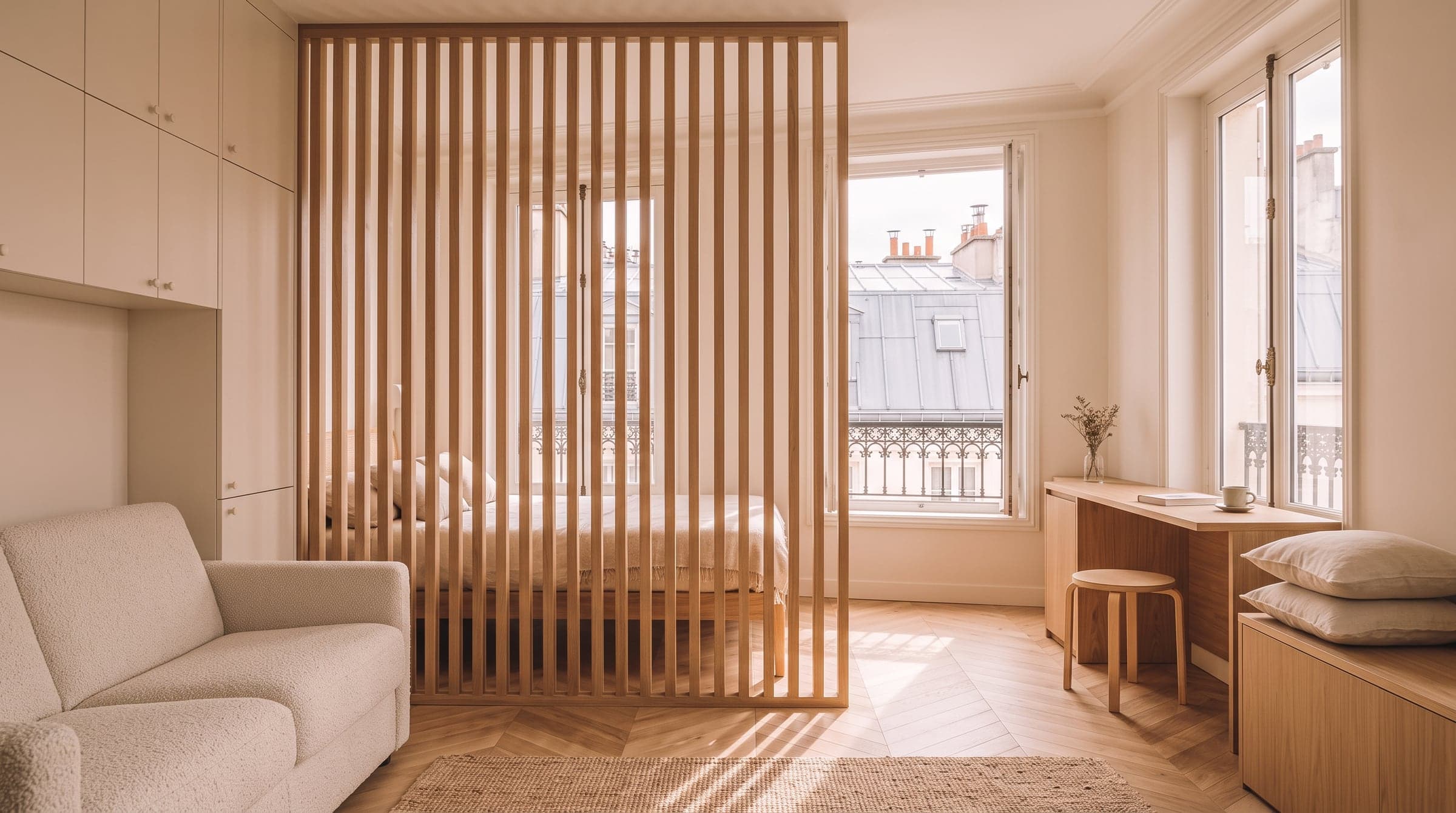
If the separation is not going to change, a fitted joinery divider earns its keep. Drawn to the room rather than bought off a shelf, it can run floor to ceiling or sit on a low base, with a light openwork screen of wood battens that separates without stopping the light. The spacing of the battens is the real decision: closer together for a sleeping corner that wants a real sense of a room, further apart for a boundary that only needs to read as a line. Because it is fixed, it earns its place best when it is decided with the floor plan, not added once the furniture is already in.
A glazed screen, when light should not compromise
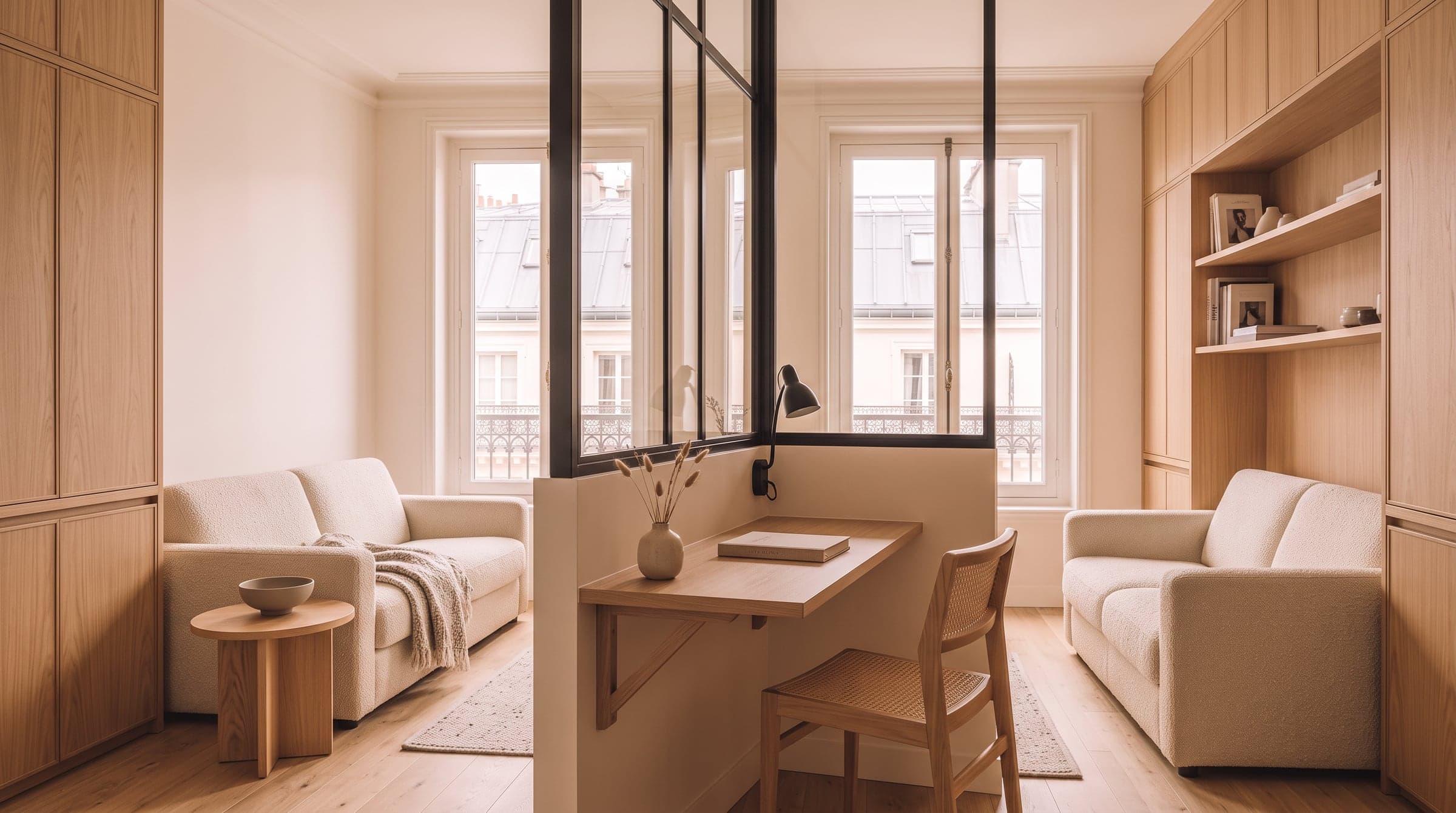
A slim steel frame with clear or reeded glass does something a solid partition cannot: it draws a line while keeping every bit of the light on both sides. It suits a home office set against a living room, or a kitchen corner next to a dining table, especially in an older Paris building where the window sits at one end of the flat. Full height, it reads as a proper room; brought down to a glazed screen on a low base, it hides a desk's clutter while still letting the ceiling mouldings run unbroken above it.
A half wall, when you need a ledge as much as a boundary
A wall raised to waist or chest height gives you two things a full-height divider cannot: a surface, and a room that still reads as one volume above it. It works well between a kitchen and a dining corner, where the ledge doubles as a serving counter, or beside a desk, where it becomes a return for books and a lamp. Some go a step further and glaze the upper half, keeping the wall's surface while adding back a slice of the openness a full glazed screen gives. In a Paris apartment with generous ceiling height, a half wall keeps that height legible in a way a full partition would flatten.
A double-sided bookcase, when storage should do double duty
Shelving accessed from both sides turns the divider into the room's storage at the same time — the furniture that makes a small room grow rather than shrink. It suits a real sleeping corner separated without being closed off, or a living-dining split where books and objects read from either seat. The shelving itself becomes the argument for one degree of separation over another: deep shelves close the sightline more than shallow ones, so the same piece can be tuned to how much the two sides should still feel like one room. For anyone renting the apartment out, it is also the option that adds the most obvious value: a built-in the next tenant sees as a feature, not a temporary fix.
The folding screen and the curtain, for renters and a trial run
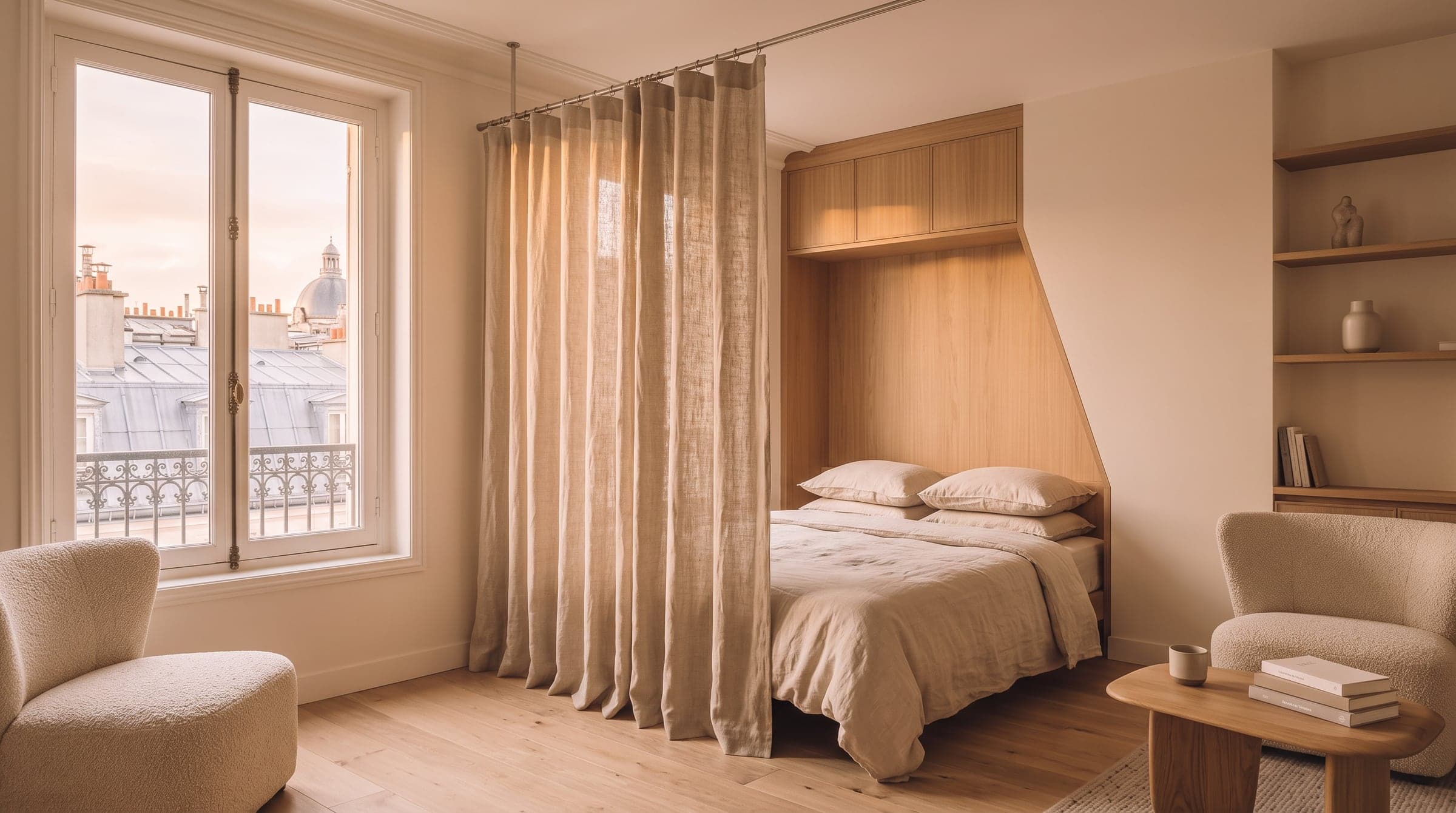
A folding screen or a tall curtain on a slim rod is not a lesser answer, only a different one. Neither asks anything permanent of an old building's walls, both fold away when the room needs to open up again, and both suit a tenant who cannot alter the flat. They are also the honest way to live with a division before committing to its exact position — we visualise the permanent version before it is built, so the trial run has a clear end point rather than becoming the answer by default.
The rest follows our project steps, from the first sketch of the plan to the drawings your builder works from, and it is exactly the kind of decision we draw into every small-space project: a room divided as far as it needs to be, and no further. Since a fixed divider is often decided alongside other work, how a renovation budget breaks down is worth a look before choosing.
FAQ
What can I use instead of a room divider?
It depends on how permanent the line should be. A fitted joinery screen or a half wall suits a separation that will not change; a glazed screen keeps the light when a solid wall would not; a double-sided bookcase adds storage while it divides. A folding screen or a curtain remains the right call for a rented flat or a division you are still testing.
What is the best room divider for a studio apartment?
For daily use, a fixed option such as a joinery screen or a double-sided bookcase tends to work best, because it stays in place and can carry storage at the same time. In a rented studio, a folding screen or a curtain does the same job without altering the flat, at the cost of feeling less settled.
Do folding screens actually block sound?
Not meaningfully. A folding screen filters sight, not sound, and a curtain does even less. If quiet matters as much as privacy, a half wall or a fitted joinery screen with closely spaced battens will do far more, though neither will match a full partition for sound.
Can a room divider make a small room look smaller?
A solid, floor-to-ceiling partition often does, because it stops both light and sightline at once. An openwork screen, a glazed panel or a half wall keep the proportions of the room readable from either side, which is usually the difference between a room that feels divided and one that feels shrunk.