Custom entryway storage for narrow apartment entrances
Custom entryway storage that starts with the corridor: its width, the door's swing, and what has to stay within reach.
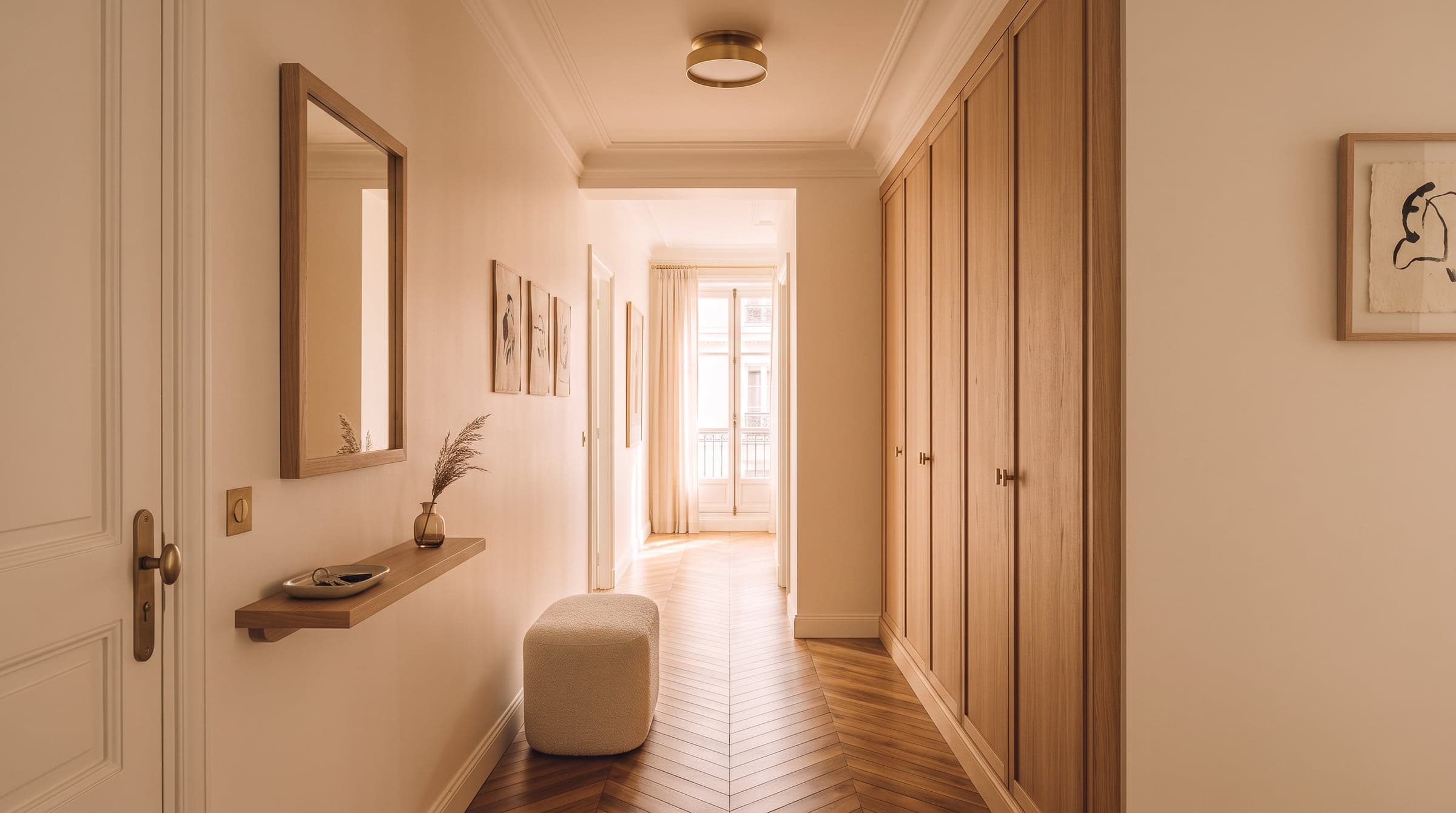
A Paris entrance is rarely a room. More often it is a corridor, sometimes barely 1 m wide, that every coat, pair of shoes and set of keys has to pass through several times a day. Custom entryway storage starts from that corridor rather than from a catalogue of cabinets: its width, the door swinging into it, and what has to be within reach the moment you walk in.
The entrance is a corridor, not a room
Before choosing what to store, it helps to look at the entrance as a passage rather than a room waiting to be furnished. A comfortable corridor keeps at least 70 cm of clear width once any storage is in place — narrower than that, and two people cannot pass each other without turning sideways.
That single measurement decides everything that follows. It sets the maximum depth the storage can take, which in turn decides what can realistically be stored inside it, measured in the actual corridor rather than guessed from a floor plan. The same logic that keeps an entrance clear applies further down the flat, in hallway storage ideas for the rest of the passage.
Depth is the first decision
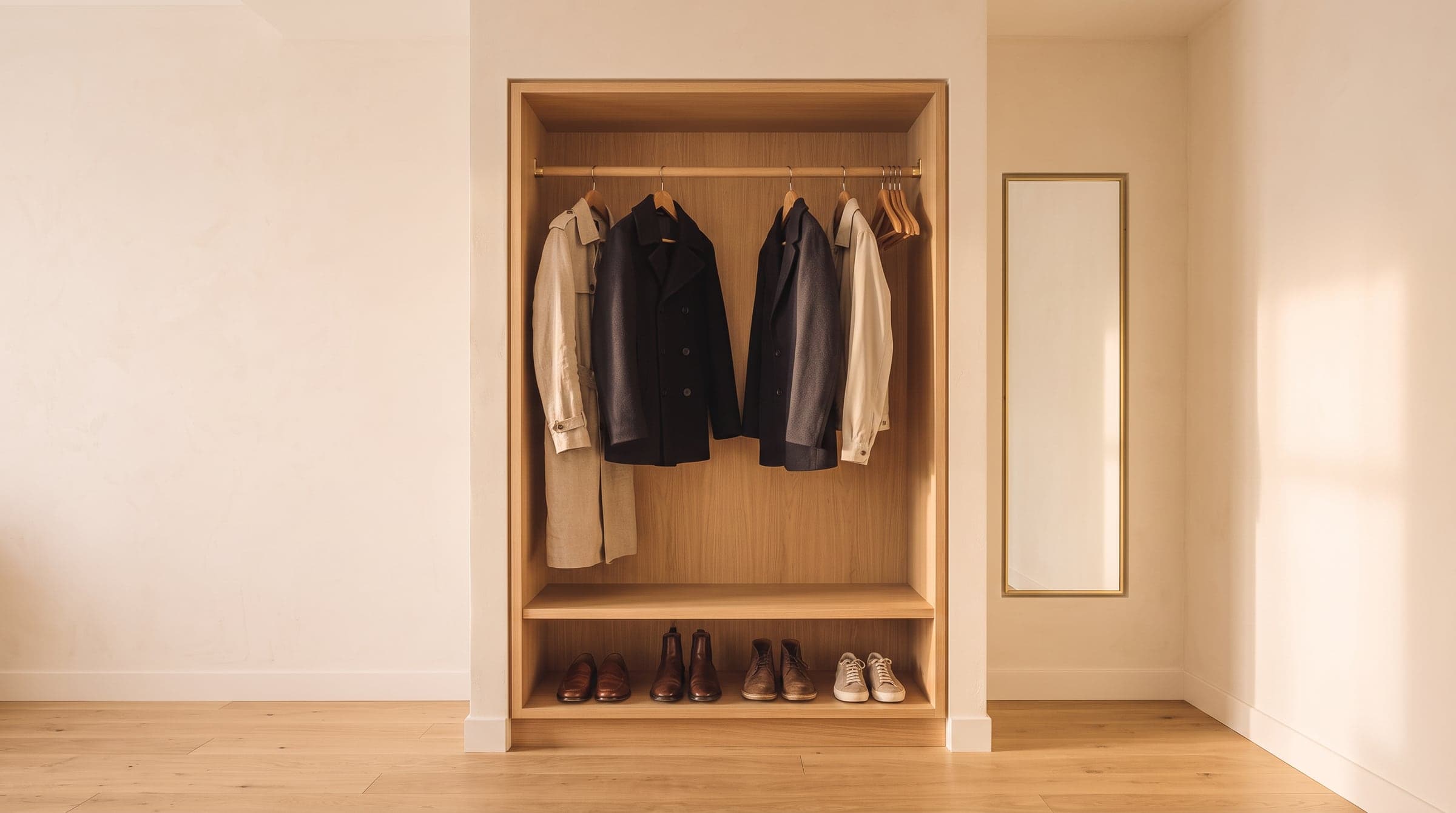
A standard wardrobe needs around 55-60 cm of depth to hang a coat facing outward. Most Paris entrances cannot spare that much wall. The answer is an angled rail: coats hang at a slight diagonal instead of square to the door, which brings the usable depth down to 35-40 cm without creasing the fabric.
Shoes follow the same logic, and gain even more from it. Stored at an angle, toes pointing inward, a pair needs only 25-30 cm of depth — roughly half of what a front-facing shoe rack would take for the same number of pairs.
Length matters less than it seems, because a narrow entrance is almost always solved by height rather than width. A tall, narrow unit rising close to the ceiling holds as much as a low, wide one spread along the whole corridor, without asking for a single extra centimetre of the width you need to keep clear.
The entrance is a passage first — no storage should ever cross that line.
What a Paris entrance actually needs to hold
Nearly every household stores the same handful of things by the door, even if the exact mix differs: coats and jackets for the current season, everyday shoes kept low and easy to reach, and the small objects that otherwise end up scattered across every flat surface nearby — keys, post, an umbrella, a phone charger. A pushchair or a vacuum cleaner is often the one bulky item that also needs a place, even if it only fits standing on end.
Deciding this list before drawing a single shelf is what keeps the interior useful rather than merely tidy on paper. A household with children usually needs shoes at a lower height they can reach themselves; a household without tends to prefer everything hidden behind a door, even at the cost of a few extra seconds each morning.
The door's swing sets the plan
A front door opening inward sweeps a quarter-circle that no piece of storage can cross. That arc has to be measured precisely, and it often rules out the spot that looked most obvious for a cabinet.
Two options recover that space. The storage can sit just clear of the door's swing, even if that means a narrower unit than the wall would otherwise allow. Or the storage itself can use sliding doors rather than hinged ones, since a sliding front adds no swing of its own and never meets the front door halfway.
A front door that opens outward, onto the landing, removes this constraint entirely — the full width of the entrance becomes available for storage, which is one of the few cases where a Paris building's older door hardware works in the apartment's favour rather than against it.
Open hooks or closed doors
Two registers work well together in an entrance, and a piece drawn for the space can hold both at once. Closed doors hide the everyday clutter — mismatched shoes, a damp coat on a rainy day — and keep the entrance looking calm to anyone arriving from outside. Open hooks, by contrast, hold what gets used every single day without requiring a door to be opened at all: this morning's coat, the bag picked up again on the way out.
Most projects settle on a mix: a closed section for the bulk of what needs storing, and two or three hooks, or a small open shelf, for the handful of things touched every day.
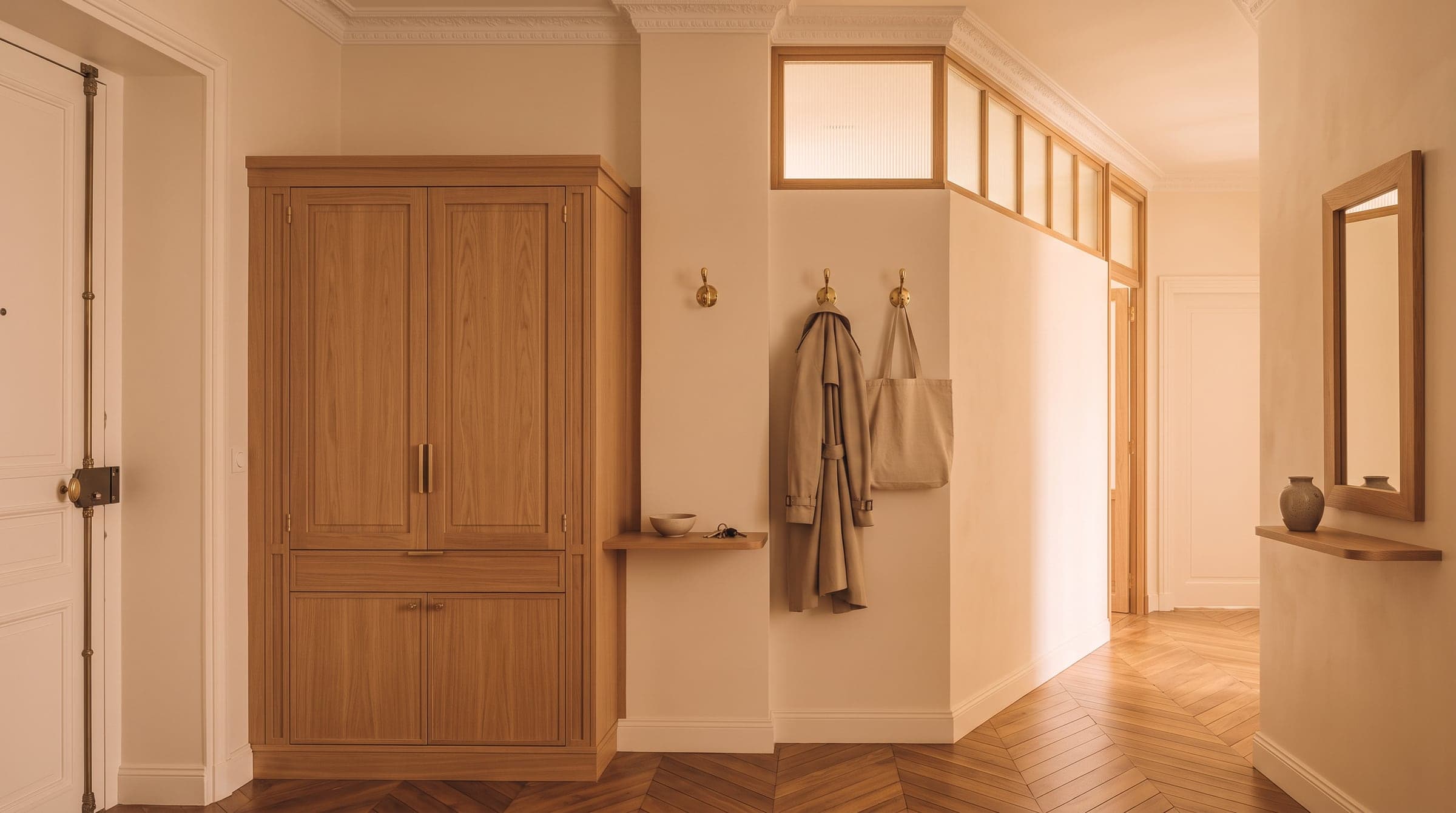
Designed for owners who are not always there
Many Paris apartments used this way belong to owners who live abroad, rent the flat out, or visit only a few times a year — which makes an entrance that works without daily attention even more valuable, since nobody is on hand to tidy it between visits. Designing it does not require being in the room: perspectives drawn from precise measurements show exactly what the finished piece will look like against the real wall, and we communicate throughout in written English and drawings that need no translation, for clients living abroad.
That same approach applies across the custom furniture we design, and it suits a small apartment just as well as a grand one: a single piece, drawn to a specific wall, doing the work a catalogue unit never quite manages. A single piece like this rarely changes a budget on its own, but how a renovation budget breaks down is worth a look.
FAQ
How much clearance should stay in front of an entryway door?
Keep at least 70 cm of clear passage once any storage is in place. Below that, two people cannot pass each other comfortably, and a pushchair or a suitcase struggles to get through at all.
What depth works for a narrow Paris entrance?
35-40 cm suits coats hung on a slightly angled rail, and 25-30 cm suits shoes stored at an angle rather than facing forward. Both use roughly half the depth a standard front-facing layout would need.
Can a single custom piece handle coats, shoes and everyday items together?
Yes, and combining them in one piece is usually more efficient than three separate ones. A closed section holds coats and shoes out of sight, while a small open shelf or a couple of hooks nearby keep keys, post and the coat worn every day within easy reach.
Is it possible to design entryway storage without visiting the apartment in person?
Yes. Precise measurements and photographs are enough to draw the piece and produce perspectives showing it in place, which is how we design for owners living abroad or renting their Paris apartment out.